
There is a shelf in almost every Singapore kitchen that nobody opens. It sits just above comfortable reach, holds the serving dishes you use twice a year, and quietly represents a few hundred dollars of carpentry doing nothing at all.
Motorised cabinet lifts exist to reclaim that shelf. At the press of a button, the contents of a high or low cabinet travel to you, instead of you reaching for them. This guide covers how the systems work, which of the seven One Touch systems suits which cabinet, what they cost, and when they are honestly not worth it.
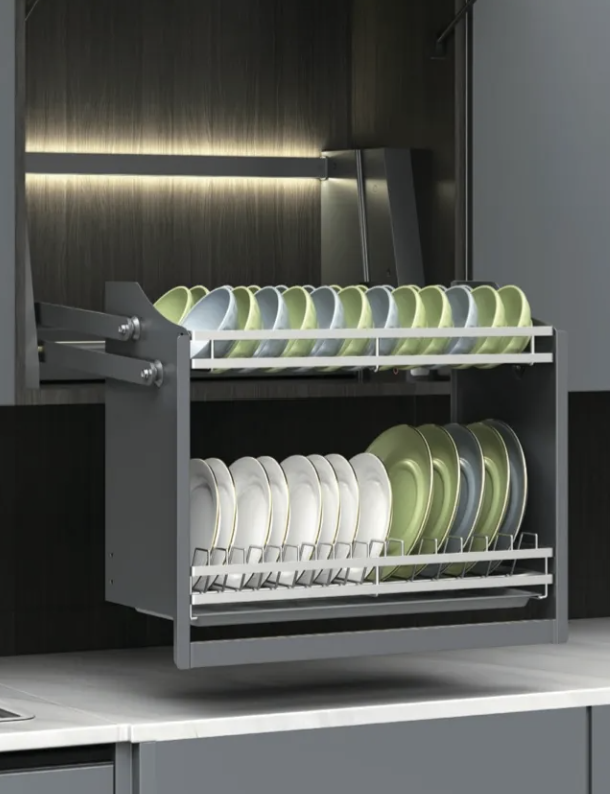
Vaseria, lowered. The dish rack meets you at counter height rather than above your shoulders.
What is a motorised cabinet lift?
A powered mechanism installed inside a cabinet, which raises or lowers a shelf, rack, rail or platform along a track to a preset position.
The difference from a manual pull-down basket is felt rather than read. A manual system asks you to pull a loaded rack down and push it back up, which is an awkward gesture with both hands full of wet plates. A motorised one asks for a fingertip. Travel is governed by the motor rather than by gravity and a gas strut, so the movement is even, and it stops where it is meant to stop.
The systems are rated to 20kg, which comfortably covers a full dinner service or a loaded pantry shelf.
The trade-off is planning. A motorised system needs power inside the cabinet, which means it belongs in the drawings before carpentry starts, not in a wishlist afterwards.
The seven systems
Vaseria: automatic dish rack lift
The dish rack descends to counter height for loading and unloading, then retracts into the overhead cabinet. This is the system most Singapore kitchens will notice daily, because dish racks are almost always mounted above the sink at a height that turns unloading into a two-handed reach on tiptoe.
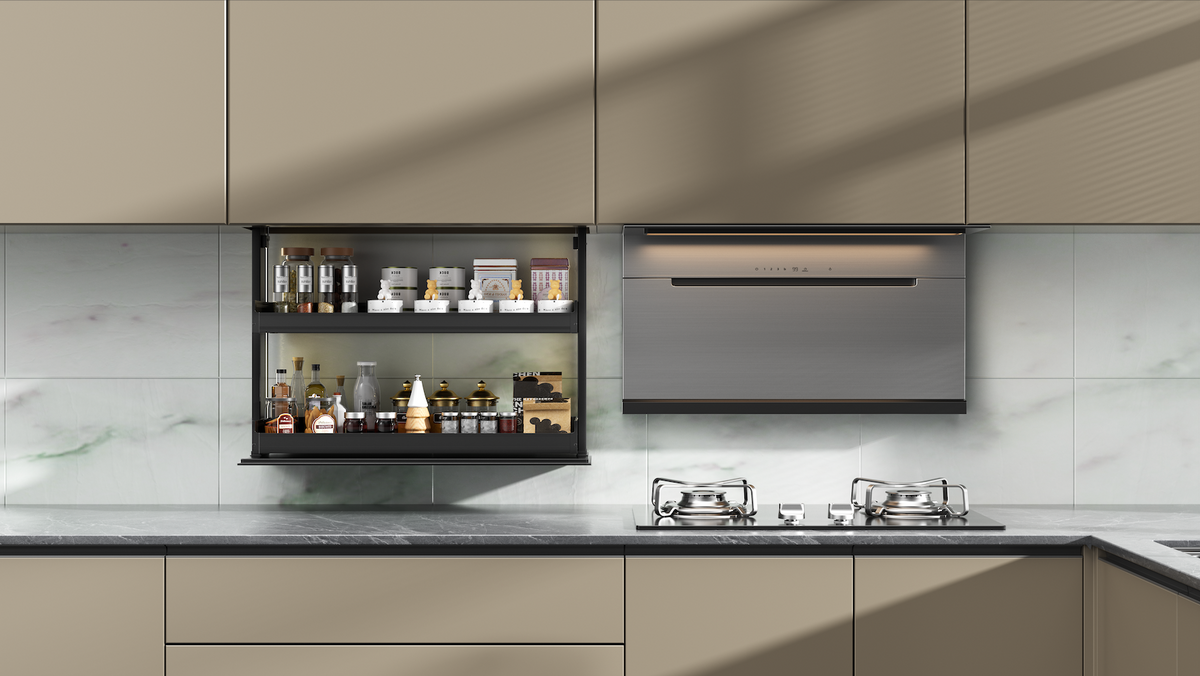
Nasconda: automatic lift rack system
A concealed rack that comes down from an overhead cabinet. General storage, retrieved rather than reached for. The name is Italian for "it hides", which is the point: the mechanism is invisible until the moment it is useful.

Velario: automatic smart cabinet door lift
Lifts an overhead door upward and holds it there. Suited to a continuous run of wall cabinets where a swing door would break the line of the kitchen, or meet your forehead.
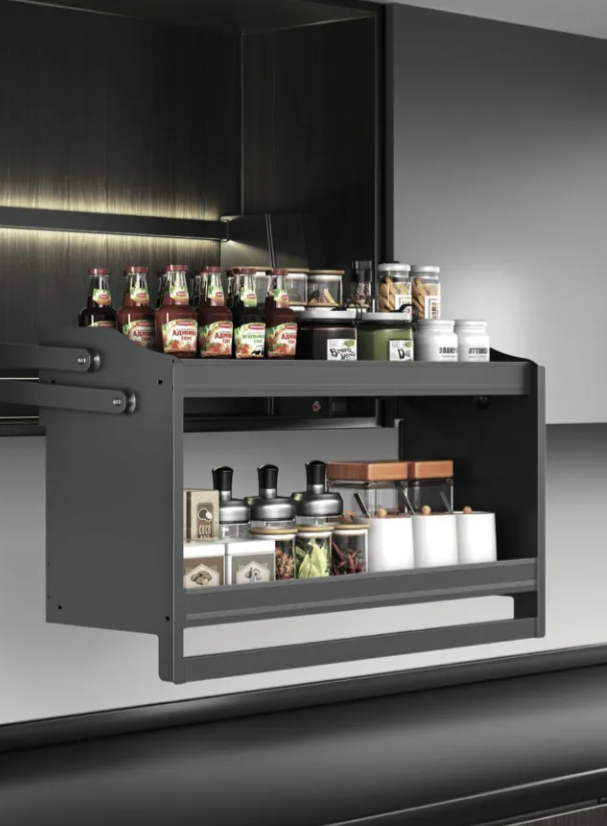
Strato: automatic double-layer cabinet lift
Two tiers descending together. For deeper overhead cabinets where a single shelf leaves vertical space unused above it.
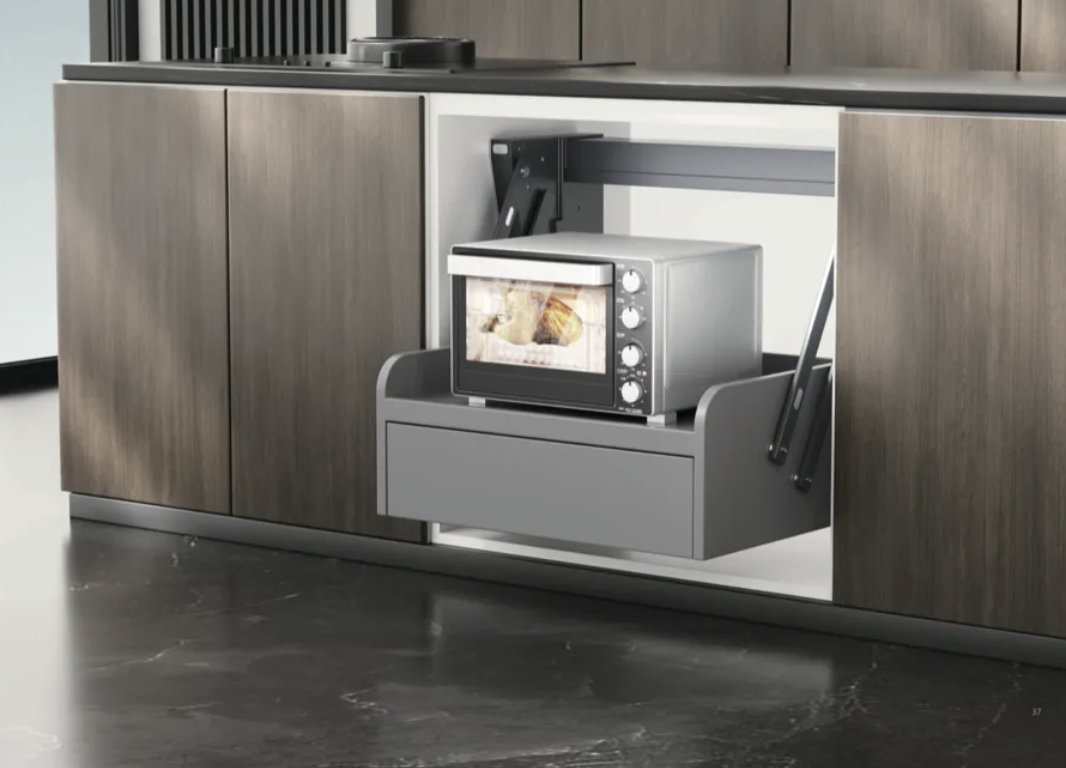
Podio: automatic base cabinet lift platform
The same idea inverted. A platform inside a base cabinet rises to counter level, bringing a stand mixer or rice cooker up to you rather than asking you to fold yourself into a cupboard to fetch it. If you have ever wrestled a KitchenAid out of a low cabinet, this is the one.
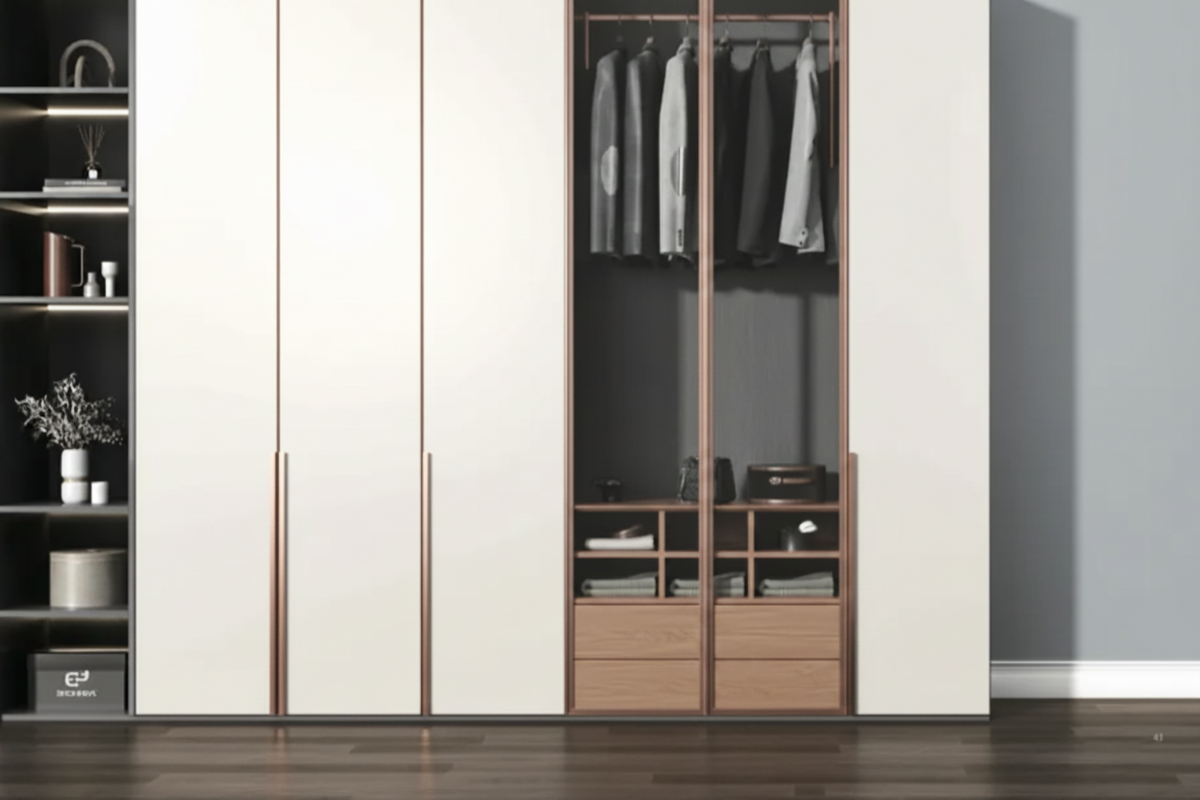
Sospeso: automatic wardrobe hanging rail
Lowers a hanging rail from the upper section of a wardrobe. Relevant to any wardrobe built to ceiling height, where the top rail otherwise becomes seasonal storage by default rather than by choice.
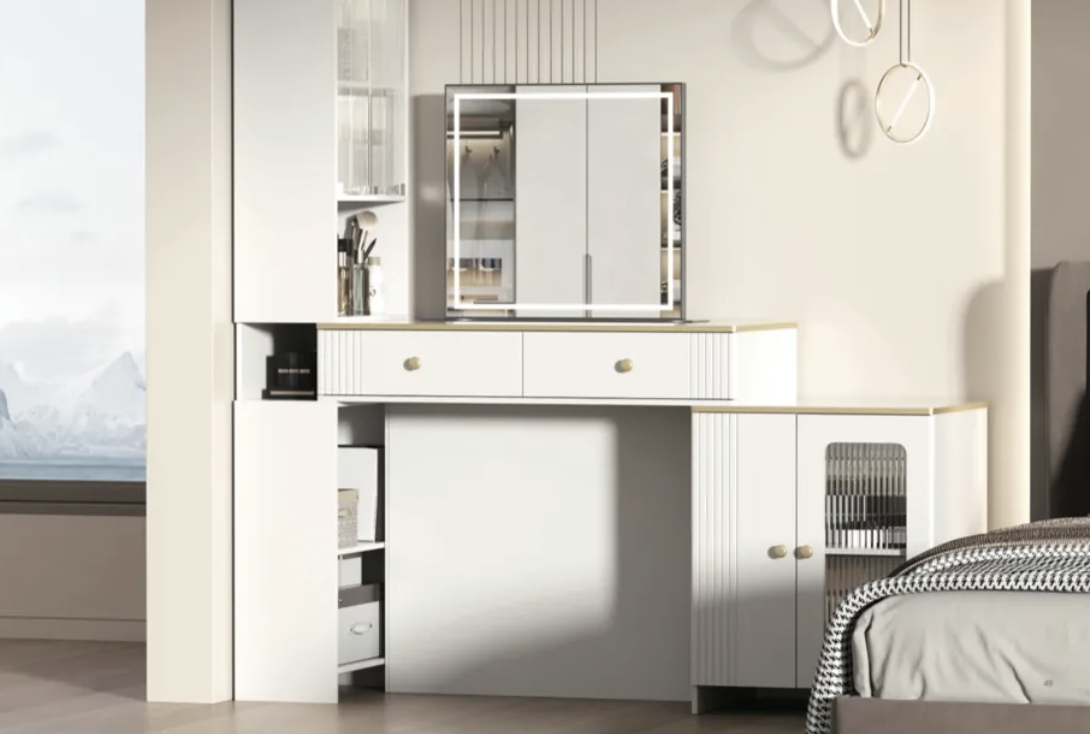
Riflesso: automatic rising mirror lift
A mirror that rises to reveal what sits behind it. A dressing area or bathroom application, and the most theatrical of the seven.
What they cost in Singapore
One Touch systems are priced at $2,888 to $2,988 SGD per system, depending on model and configuration.
A manual pull-down basket for the same cabinet costs a fraction of that. You are paying for the motor, the controller, the damping and the warranty behind them, not for the storage.
Which is why most homeowners fit one or two systems at the points of daily friction, typically the dish rack and one overhead cabinet, rather than motorising a kitchen wholesale. It reads better as a considered choice than as a specification sheet anyway.
Whether it is right for your home
A note on this, because a motorised lift in the wrong cabinet is an expensive ornament.
It earns its place when:
- Someone in the household has limited reach, whether through height, age or injury. This is the strongest case by a distance, and the one where the system stops being a luxury.
- Your cabinetry runs to the ceiling and the top tier is dead storage.
- Heavy appliances live in base cabinets and get moved often.
- You are specifying a premium kitchen where the cost sits comfortably inside the budget.
Worth pausing if:
- Your cabinets stop at standard height and everything is already within reach.
- The renovation budget is tight. Spread across better hinges, runners and carcass material, the same money improves every cabinet in the house rather than one.
- The cabinet in question holds things you open twice a year. A good step stool costs thirty dollars and asks nothing of your electrician.
What to check before you specify one
Power supply
The system needs a power point, agreed with your electrician and your ID before cabinetry goes up so the socket sits inside the carcass and stays out of sight. Adding power to a finished cabinet means opening up the backing, which is not a small job.
Cabinet dimensions
Each system has minimum internal width, depth and height. Check these against your carpentry drawings before the cabinet is built.
Load rating
20kg. A twelve-piece dinner service with serving pieces sits well within it. A cast-iron collection may not.
Carcass strength
The cabinet carries the mechanism, the load, and the force of travel. Confirm your carpenter is building to suit, particularly at the top and side panels where the mechanism anchors.
Build and warranty
The systems use aluminium alloy construction with hydraulic-controlled damping, so travel stays even across cycles and the mechanism settles into its stop rather than arriving with a knock. It is the kind of engineering you only notice in its absence.
Motors carry a 10-year warranty, which is the number that matters most on any motorised product. The motor is the part that eventually fails and the part you cannot substitute generically. Two questions worth asking any supplier of automated cabinet hardware: how long is the motor covered, and can a replacement still be sourced in year eight. A system with no parts pipeline has an expiry date whether or not anyone prints one on it.
Frequently asked questions
Do motorised cabinet lifts work in HDB flats?
Yes. The One Touch systems are designed for standard HDB and condominium cabinetry and need no structural modification to the flat. What they do need is planning at the carpentry and electrical stage.
What happens during a power cut?
The mechanism stops where it is.
Are they noisy?
Damping controls the stop, so what you hear is motor travel rather than an impact at the end. Tolerance for motor noise varies more between people than most other hardware qualities, so this is one to judge with your own ears.
Can they be installed in an existing kitchen?
Occasionally, if the cabinet dimensions happen to suit and power can be routed without major work. In practice most installations happen during a renovation, because the cabinet is built around the mechanism rather than the other way round.
Come and use one
Motion does not photograph. Travel speed, motor sound, and how a mechanism feels as it settles are the three things that decide whether you will enjoy the system every day for ten years, and none of them survive a product image.
All seven systems are installed and running at the Excel Brand Experience Centre, 10 Admiralty Street #03-35, Northlink Building. Bring your carpentry drawings if you have them and we can tell you on the spot which systems your cabinets will take.


